
Navratri 2026
Nine nights for the nine forms of Maa Durga. Here are the confirmed 2026 dates, the day-by-day calendar, Ghatasthapana muhurat, colors, puja steps, vrat rules and everything else in one place.
Dates follow the widely used North-India (Ashwin Shukla Paksha) calendar. Exact muhurat and tithi timings shift by city — always cross-check your local Panchang. Bengal Durga Puja uses a slightly different day count (see Ashtami & Navami).
Navratri Day 1 — Maa Shailputri
Ghatasthapana and the first day of worship; devotees set up the kalash and begin the nine-day sankalp.
On this page
- Navratri 2026 at a glance
- 9-day Navratri calendar
- Today’s Navratri
- Nine forms of Maa Durga
- Navratri colors 2026
- Ghatasthapana 2026
- Navratri puja vidhi
- Puja samagri checklist
- Mantra, aarti & prayers
- Navratri vrat / fasting
- Durga Ashtami 2026
- Mahanavami 2026
- Kanya Pujan
- Why Navratri is celebrated
- Navratri across India
- Chaitra vs Sharad Navratri
- Navratri food
- Navratri wishes 2026
- FAQs
Navratri 2026 at a glance
The full arc of the festival, from Ghatasthapana on the first morning to Dussehra on the tenth day.
| Date | Day | Tithi | Observance |
|---|---|---|---|
| Oct 11 | Sunday | Pratipada | Ghatasthapana · Shailputri Puja |
| Oct 12 | Monday | Dwitiya | Brahmacharini Puja |
| Oct 13 | Tuesday | Tritiya | Chandraghanta Puja |
| Oct 14 | Wednesday | Chaturthi | Kushmanda Puja |
| Oct 15 | Thursday | Panchami | Skandamata Puja · Lalita Panchami |
| Oct 16 | Friday | Shashthi | Katyayani Puja · Bengal Durga Puja begins |
| Oct 17 | Saturday | Saptami | Kalaratri Puja · Maha Saptami |
| Oct 18 | Sunday | Ashtami | Mahagauri Puja · Durga Ashtami · Kanya Pujan |
| Oct 19 | Monday | Navami | Siddhidatri Puja · Maha Navami · Havan |
| Oct 20 | Tuesday | Dashami | Vijayadashami / Dussehra |
Why 2026 has 10 calendar days for 9 nights
In 2026 the Saptami tithi stretches across two sunrises (Oct 17 and Oct 18 in many Panchangs), so the festival spans ten Gregorian dates even though only nine tithis — Pratipada through Navami — are worshipped. This is a normal lunar-calendar variation and is the main reason different calendars occasionally show a day’s difference. Follow the Panchang your family uses.
Navratri 2026 calendar — day by day
Each day honours one form of the Navadurga. Colors below follow the commonly shared North-India sequence; bhog and mantra are the traditional associations for each goddess.
- Significance
- Daughter of the mountains; the festival opens with Ghatasthapana.
- Mantra
- ॐ देवी शैलपुत्र्यै नमः
- Bhog
- Pure desi ghee
- Ritual
- Kalash Sthapana, barley sowing, first-day sankalp.
- Significance
- Goddess of penance and devotion; symbol of discipline.
- Mantra
- ॐ देवी ब्रह्मचारिण्यै नमः
- Bhog
- Sugar / mishri
- Ritual
- Recitation of Durga stotra; offering of white flowers.
- Significance
- Wears a half-moon shaped like a bell; grants courage, removes fear.
- Mantra
- ॐ देवी चन्द्रघण्टायै नमः
- Bhog
- Milk / kheer
- Ritual
- Offering of red flowers such as hibiscus.
- Significance
- Said to have created the cosmos with her smile; the source of energy.
- Mantra
- ॐ देवी कूष्माण्डायै नमः
- Bhog
- Malpua
- Ritual
- Recitation of Kushmanda stotra and Durga Saptashati.
- Significance
- Mother of Skanda (Kartikeya); grants wisdom and wellbeing.
- Mantra
- ॐ देवी स्कन्दमातायै नमः
- Bhog
- Banana
- Ritual
- Also marks Lalita Panchami in some regions.
- Significance
- Warrior form born to slay Mahishasura; fierce and protective.
- Mantra
- ॐ देवी कात्यायन्यै नमः
- Bhog
- Honey
- Ritual
- Bengal Durga Puja Bodhon (invocation) begins on Shashthi.
- Significance
- The fierce, dark destroyer of ignorance; also called Shubhankari.
- Mantra
- ॐ देवी कालरात्र्यै नमः
- Bhog
- Jaggery (gur)
- Ritual
- Maha Saptami and the Nabapatrika ritual in Bengal.
- Significance
- Radiant, serene form who forgives and purifies; worshipped on Durga Ashtami.
- Mantra
- ॐ देवी महागौर्यै नमः
- Bhog
- Coconut
- Ritual
- Durga Ashtami puja, Kanya Pujan, Sandhi Puja.
- Significance
- Bestower of siddhis (accomplishments); completes the nine-night cycle.
- Mantra
- ॐ देवी सिद्धिदात्र्यै नमः
- Bhog
- Sesame (til) / halwa-puri-chana
- Ritual
- Maha Navami puja, havan, Kanya Pujan; fast often broken.
Mantras above use the standard beej-mantra form (ॐ देवी [name]यै नमः). Bhog and color associations are traditional and can differ by family and region.
The nine forms of Maa Durga
Together the nine forms are called the Navadurga. Each is worshipped on one night, moving from the goddess’s birth as the mountain’s daughter to her final form as the giver of all accomplishments.
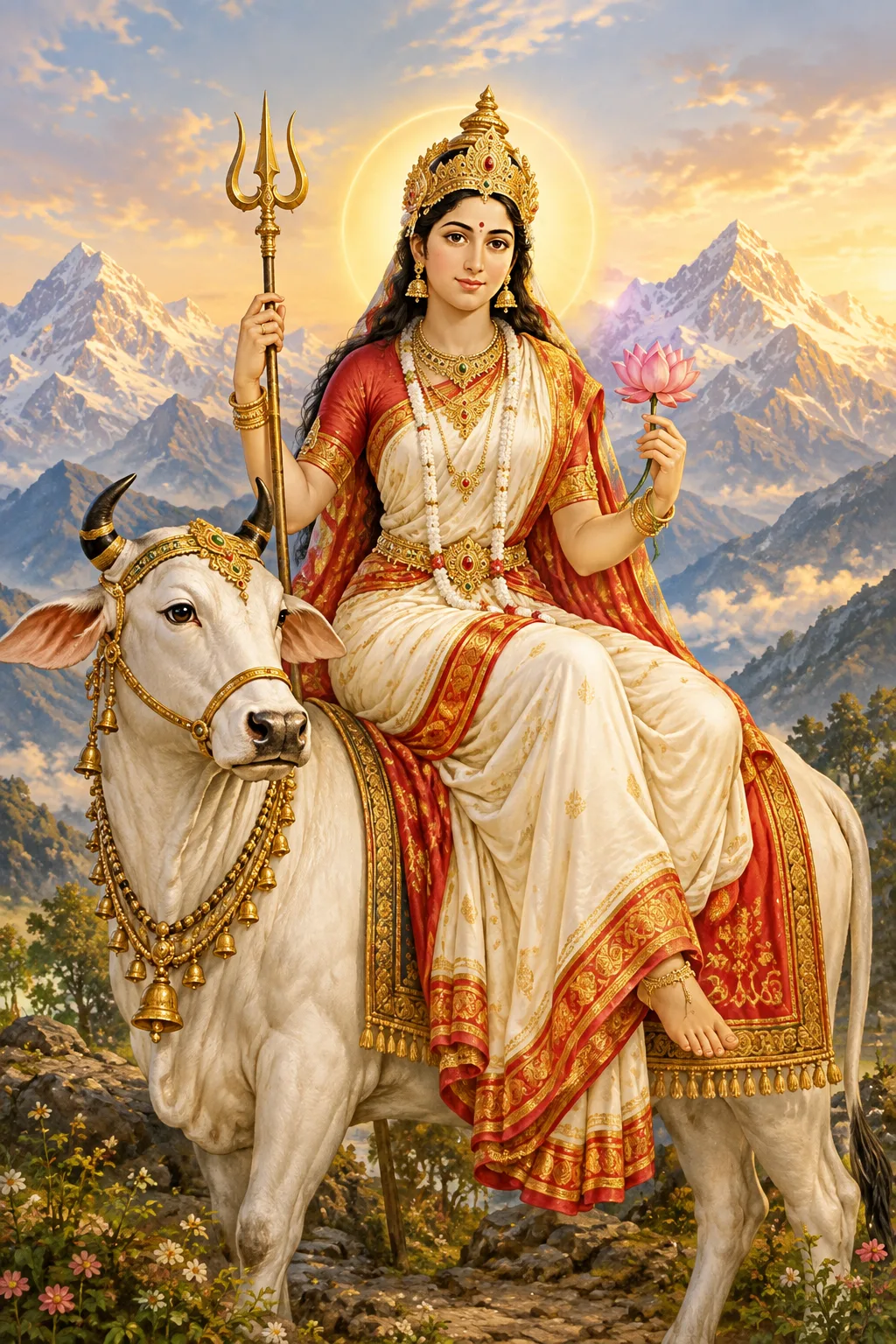
1 Maa Shailputri
“Daughter of the mountain”
The first form of Navadurga, a manifestation of Parvati as the daughter of Himavan. She represents the pure, primal power of nature and roots the whole festival in devotion to Shakti.
Mantra: ॐ देवी शैलपुत्र्यै नमः · Bhog: ghee
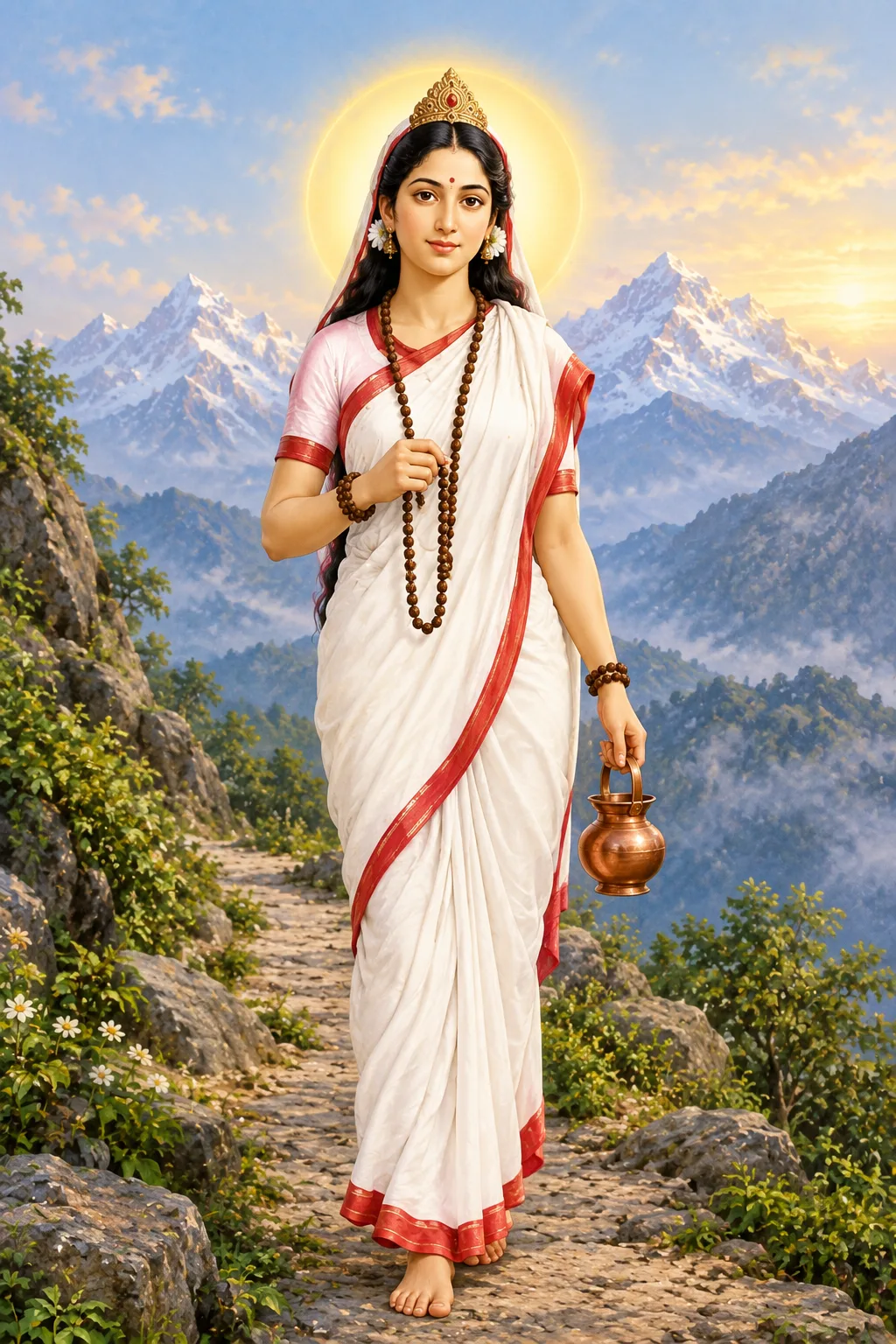
2 Maa Brahmacharini
“One who practises devout austerity”
Depicted walking barefoot, holding a japa mala and kamandalu. She embodies penance, patience and single-minded devotion, and blesses seekers with restraint and inner strength.
Mantra: ॐ देवी ब्रह्मचारिण्यै नमः · Bhog: sugar
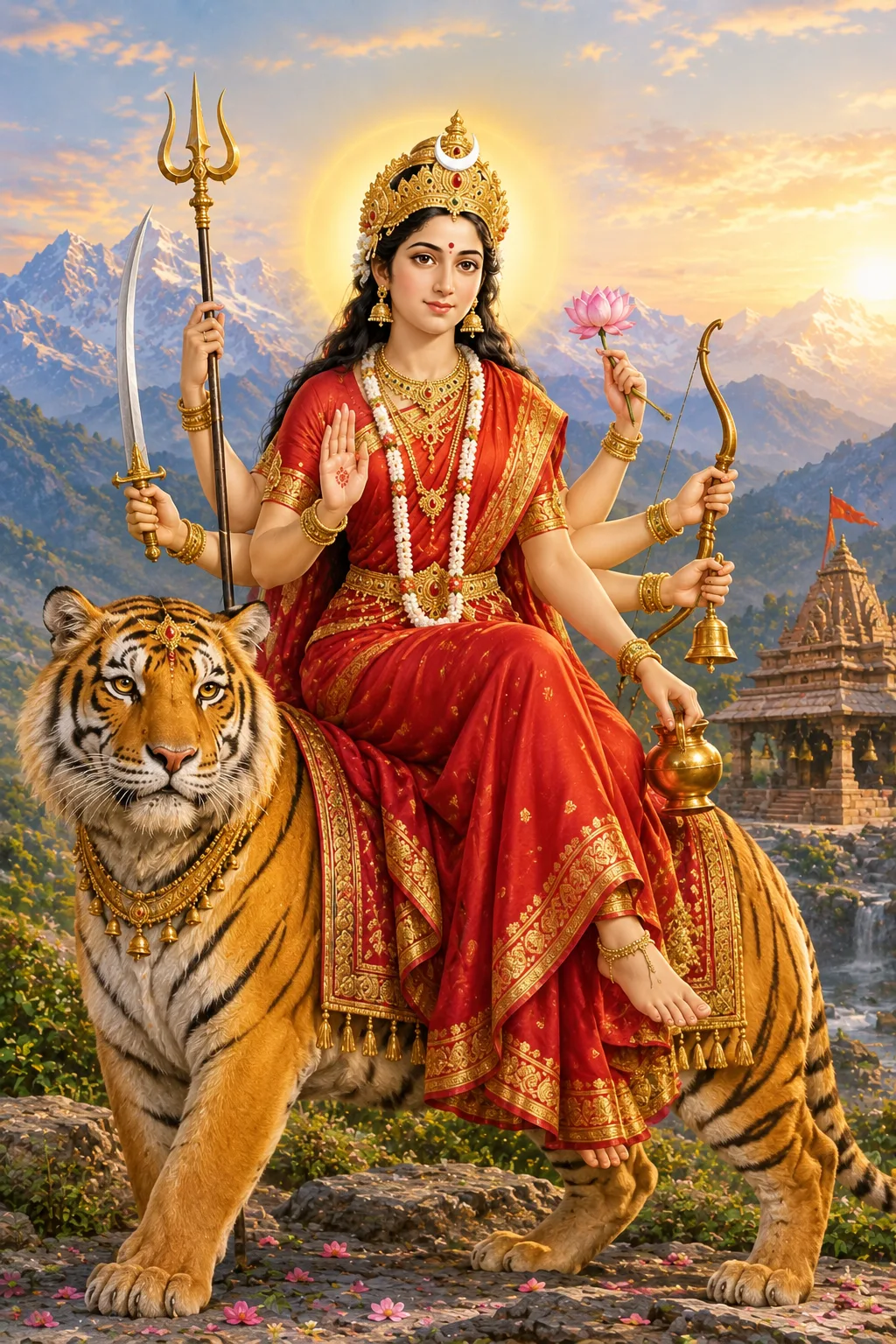
3 Maa Chandraghanta
“She who bears the moon like a bell”
Named for the half-moon shaped like a ghanta (bell) on her forehead. A golden, ten-armed warrior form, she rewards courage and is believed to drive away fear and negativity.
Mantra: ॐ देवी चन्द्रघण्टायै नमः · Bhog: milk / kheer
4 Maa Kushmanda
“The cosmic egg” — creator of the universe
Believed to have created the cosmos with her radiant smile and to reside within the sun, giving it its light. The eight-armed goddess is the source of vitality and good health.
Mantra: ॐ देवी कूष्माण्डायै नमः · Bhog: malpua
5 Maa Skandamata
“Mother of Skanda (Kartikeya)”
Shown seated on a lotus with the infant Skanda in her lap. A tender, maternal form, she is worshipped for wisdom, prosperity and the wellbeing of children.
Mantra: ॐ देवी स्कन्दमातायै नमः · Bhog: banana
6 Maa Katyayani
“Daughter of sage Katyayana”
A fierce warrior form, closely linked with the slaying of the demon Mahishasura. She is invoked for strength and the removal of obstacles, and is traditionally worshipped by those seeking a good match.
Mantra: ॐ देवी कात्यायन्यै नमः · Bhog: honey
7 Maa Kalaratri
“The dark night” — destroyer of darkness
The most ferocious form: dark-complexioned, wild-haired and fearless, she annihilates ignorance and evil. Despite her fierce appearance she is also called Shubhankari, “the one who does good.”
Mantra: ॐ देवी कालरात्र्यै नमः · Bhog: jaggery
8 Maa Mahagauri
“The extremely radiant one”
Serene and luminous, dressed in white and seated on a bull. She is believed to wash away sins and grant peace, and is worshipped on Durga Ashtami, one of the festival’s most important days.
Mantra: ॐ देवी महागौर्यै नमः · Bhog: coconut
9 Maa Siddhidatri
“Giver of siddhis” (perfections)
The final form, seated on a lotus and worshipped by gods, sages and humans alike. She grants all accomplishments and spiritual attainments, bringing the nine-night journey to completion on Maha Navami.
Mantra: ॐ देवी सिद्धिदात्र्यै नमः · Bhog: sesame / halwa
Navratri colors 2026
Wearing a color a day is a modern, joyful tradition that gives community celebrations, garba nights and temple visits a shared look. The sequence below is the widely shared North-India convention for 2026 — some regions and Panchangs order the colors differently.
| Day | Date | Goddess | Color | What it stands for |
|---|---|---|---|---|
| 1 | Oct 11 | Shailputri | Orange | Warmth, energy, enthusiasm |
| 2 | Oct 12 | Brahmacharini | White | Purity and peace |
| 3 | Oct 13 | Chandraghanta | Red | Strength, passion, the goddess’s chunri |
| 4 | Oct 14 | Kushmanda | Royal Blue | Divine energy and calm |
| 5 | Oct 15 | Skandamata | Yellow | Brightness and optimism |
| 6 | Oct 16 | Katyayani | Green | Growth, nature, new beginnings |
| 7 | Oct 17 | Kalaratri | Grey | Balance and grounded strength |
| 8 | Oct 18 | Mahagauri | Purple | Grandeur and ambition |
| 9 | Oct 19 | Siddhidatri | Peacock Green | Individuality and freshness |
Quick answers
What is today’s Navratri color? See the live Today’s Navratri box above — it updates automatically each day.
What should I wear during Navratri? Any comfortable outfit in the day’s color is enough. There is no rule that you must follow the colors — it is a shared custom, not a requirement.
Do the colors change every year? The nine colors stay the same, but their order shifts because it’s tied to the weekday each day falls on. That’s why the 2026 sequence may differ from what you wore last year.
Ghatasthapana 2026
Ghatasthapana (also called Kalash Sthapana) is the opening ritual of Navratri: a sacred pot is installed to invoke Goddess Shakti, and barley seeds are often sown as a symbol of prosperity. It anchors the goddess in the home for all nine nights.
Ghatasthapana Muhurat New Delhi example
Date: Sunday, 11 October 2026 · Tithi: Ashwin Shukla Pratipada
Morning muhurat (New Delhi): approx. 6:19 AM – 10:12 AM
Abhijit muhurat (New Delhi): approx. 11:44 AM – 12:31 PM (a fallback window if the morning slot is missed)
Important: the timings above are calculated for New Delhi and are shown only as an example. Sunrise, sunset and tithi start/end times differ from city to city, so your local Ghatasthapana muhurat will be different. Always check a reliable Panchang for your own location, and avoid Rahu Kaal for the ceremony.
The general rule
Ghatasthapana should be performed during Pratipada Tithi, ideally in the first one-third of the day (roughly sunrise to mid-morning). If that isn’t possible, the midday Abhijit muhurat is traditionally used. Night-time Ghatasthapana is generally avoided.
How the kalash is set up
Prepare the base
Clean the puja space and spread a layer of soil in a wide clay or metal pot. Sow barley (jau) seeds in the soil in some traditions.
Set the kalash
Place a copper or clay kalash on the soil. Fill it with clean water, and add items your family tradition uses — such as a coin, akshat (rice), a betel nut and a few drops of Gangajal.
Crown it
Arrange mango leaves around the rim and place a coconut wrapped in a red cloth on top. Tie a sacred thread (kalava) around the kalash.
Invoke the goddess
Light the diya, offer flowers, roli and akshat, and invoke Maa Durga with the sankalp (vow) for the nine days.
What to keep in mind
- Set up the kalash on clean, undisturbed ground where it can stay for all nine days.
- Keep the akhand jyot (continuous lamp) tended if your tradition keeps one burning.
- Avoid placing the kalash under a beam or in a cluttered corner.
- Practices vary widely by region and family — treat this as a general guide, not a fixed rulebook.
Navratri puja vidhi
A simple, respectful daily routine for home worship. Details differ between families and regions — adapt this to your own tradition.
Prepare the space
Bathe and wear clean clothes. Clean the altar and place the idol or image of Maa Durga along with the kalash from Ghatasthapana.
Light the lamp
Light the diya and incense. Many households keep an akhand jyot burning through all nine days.
Invoke Maa Durga
Offer water, akshat, roli and a sankalp, inviting the goddess to accept the day’s worship.
Worship the day’s goddess
Recite the name and mantra of the Navadurga form for that day (see the calendar).
Offer flowers and items
Offer fresh flowers, fruits, kumkum, and any items your tradition prescribes for that goddess.
Present the bhog
Offer the traditional bhog for the day — ghee, mishri, kheer and so on.
Recite mantra / Chalisa
Read the Durga Chalisa, chapters of the Durga Saptashati, or Devi stotras as you are able.
Perform aarti
Conclude with the Durga aarti, moving the lamp in gentle circles before the goddess.
Distribute prasad
Share the bhog as prasad among family members and guests.
You don’t need an elaborate setup to observe Navratri meaningfully. A clean space, a lamp, sincere prayer and the day’s mantra are enough for a home puja.
Navratri puja samagri checklist
A commonly used list for Ghatasthapana and daily worship. Not every household or tradition uses every item — gather what your family’s practice calls for.
- Kalash (copper or clay)
- Coconut
- Mango leaves
- Soil & barley seeds (jau)
- Roli / kumkum
- Akshat (unbroken rice)
- Fresh flowers & garland
- Diya, wicks & ghee/oil
- Incense (agarbatti / dhoop)
- Fruits
- Prasad & sweets
- Red cloth (chunri)
- Kalava (sacred thread)
- Betel nut & leaves
- Gangajal
- Camphor (kapoor)
- Panchamrit (milk, curd, ghee, honey, sugar)
- Idol or image of Maa Durga
Navratri mantra, aarti & prayers
The most commonly recited invocations during Navratri. Use full, authentic versions from a Panchang, prayer book or trusted temple source when reciting at home.
Durga beej mantra
ॐ दुं दुर्गायै नमः
A short, widely used daily mantra to invoke Maa Durga.
Navarna (Navakshari) mantra
ॐ ऐं ह्रीं क्लीं चामुण्डायै विच्चे
The nine-syllable mantra of the Devi, central to Durga Saptashati recitation.
Navadurga mantras
Each of the nine forms is worshipped with the beej-mantra form ॐ देवी [name]यै नमः — for example ॐ देवी शैलपुत्र्यै नमः on Day 1. The full set is listed in the day-by-day calendar and the nine forms section.
Durga Chalisa & Durga Aarti
The Durga Chalisa (a forty-verse hymn opening with “नमो नमो दुर्गे सुख करनी”) and the Durga Aarti (“जय अम्बे गौरी, मैया जय श्यामा गौरी…”) are recited daily by many devotees. Because they are long devotional texts, recite them from a complete, authentic source rather than a partial version — most prayer books, temple apps and Panchangs carry the standard text.
We deliberately don’t reproduce full scripture here so that the sacred text you recite is complete and correct. Please use a trusted printed or temple source.
Navratri vrat / fasting
Many devotees fast during Navratri, from a strict nine-day vrat to fasting only on the first and last days. The customs below are traditional and vary by family. This is religious observance, not dietary or medical advice — if you have any health condition, speak to a doctor before fasting.
Commonly eaten
- Vrat flours: kuttu (buckwheat), singhara (water chestnut), rajgira (amaranth)
- Samak / sama rice (barnyard millet)
- Sabudana (tapioca)
- Makhana (fox nuts)
- Fruits and fruit juices
- Dairy: milk, curd, paneer, ghee
- Potato, sweet potato, pumpkin, arbi
- Nuts and dry fruits
- Sendha namak (rock salt)
Commonly avoided
- Regular grains: wheat, rice, maida, semolina
- Ordinary table salt (rock salt used instead)
- Onion and garlic
- Non-vegetarian food and eggs
- Alcohol
- Certain regular pulses and lentils
- Some avoid turmeric, mustard and asafoetida
Common questions
Can you eat rice or wheat? Regular rice and wheat are usually avoided; samak rice and vrat flours (kuttu, singhara, rajgira) are used instead.
Can you eat fruits and dairy? Yes — fruits and dairy are staples of the vrat for most people.
When is the fast broken? Practices differ: some break it daily after the evening puja, many break the nine-day vrat on Ashtami or Navami after Kanya Pujan.
Durga Ashtami 2026
Durga Ashtami (Maha Ashtami) is one of the most important days of the festival, dedicated to Maa Mahagauri. It is a peak day for Kanya Pujan, and for Sandhi Puja in the Durga Puja tradition.
Durga Ashtami key facts
Date (general Navratri): Sunday, 18 October 2026 · Goddess: Maa Mahagauri
Ashtami tithi (New Delhi example): begins approx. 8:27 AM on Oct 18 and ends approx. 10:51 AM on Oct 19. location-specific
Puja & Kanya Pujan
Devotees perform the Mahagauri puja, offer coconut as bhog, and many families hold Kanya Pujan — worshipping young girls as living forms of the goddess (see Kanya Pujan). In parts of North India, Kanya Pujan is done on Ashtami; elsewhere on Navami.
Sandhi Puja
Sandhi Puja is performed at the sacred junction of Ashtami and Navami — a window of about 48 minutes spanning the last part of Ashtami and the first part of Navami, when 108 lamps are lit and 108 lotuses offered. It is the most intense moment of Durga Puja.
Example timing: a Jharkhand / Khunti calculation places Sandhi Puja at roughly 10:27 AM – 11:15 AM on Oct 19, 2026. location-specific This is an example only — the Sandhi window is narrow and differs by location, so confirm the exact time with your local Panchang or pandal.
Bengal Durga Puja note
In the Bengal Durga Puja tradition, Maha Ashtami is celebrated with Pushpanjali, Kumari Puja and Sandhi Puja. Because Durga Puja and North-India Navratri can use slightly different day-reckoning rules, you may see Ashtami listed on Oct 18 in some calendars and Oct 19 in others — this is a calendar difference, not an error. Follow the panjika your community uses.
Kanya Pujan
Kanya Pujan (also called Kanjak or Kumari Puja) is the worship of young girls as living embodiments of the goddess. It is one of the most cherished customs of the festival’s final days.
When: Usually on Ashtami (Oct 18) or Navami (Oct 19), depending on family tradition. Why: the girls are honoured as forms of the Devi, and welcoming and feeding them is seen as directly serving the goddess.
How it is done
- An even number of young girls (traditions vary; often between two and nine) is invited, sometimes with a young boy representing Bhairav.
- Their feet are washed, tilak is applied, and a kalava is tied on the wrist.
- They are offered bhog — commonly puri, kala chana and sooji halwa.
- Gifts such as money, fruit, bangles or small items are given with respect, and their blessings are sought.
Customs around the number of girls, their age and the food offered vary widely by region and family. There is no single mandatory form — the spirit of respect and hospitality is what matters most.
Why is Navratri celebrated?
Navratri means “nine nights.” At its heart, it is a celebration of Shakti — the divine feminine energy — and the triumph of good over evil.
The best-known story tells of Mahishasura, a shape-shifting buffalo demon granted a boon that no man or god could kill him. Emboldened, he terrorised the three worlds. In response, the gods combined their energies to create Durga, a goddess of immense power. The two battled for nine nights, and on the tenth day Durga slew Mahishasura — which is why the day after Navratri is Vijayadashami, the “victory tenth.”
Across the nine nights, devotees worship the nine forms of Durga, moving from her gentlest to her fiercest and back to her most complete. Beyond the mythology, the festival carries a spiritual meaning: turning inward, practising discipline through fasting and prayer, and invoking the strength to overcome one’s own inner “demons.”
The Mahishasura legend is one telling among several — different regions honour Durga through their own stories and traditions. What unites them is the theme of Shakti and the victory of good over evil.
How Navratri is celebrated across India
The same nine nights take strikingly different forms across the country — and even within a single state, communities celebrate in their own way.
Gujarat
Nights of Garba and Dandiya Raas, with dancers circling a central lamp or image of the goddess in dazzling traditional dress.
West Bengal
Durga Puja — elaborate pandals, artistic idols, dhaak drumming, Pushpanjali, Sandhi Puja and Sindoor Khela, recognised by UNESCO as Intangible Cultural Heritage.
Maharashtra
Ghatasthapana at home, daily devi worship, and community garba, with the akhand jyot kept burning through the nine days.
Bihar & Jharkhand
Durga Puja pandals and temple worship alongside home vrats, with vibrant local celebrations and Sandhi Puja observance.
UP & North India
Fasting and daily devi puja, Ramlila performances of the Ramayana, culminating in Dussehra and the burning of Ravana effigies.
Southern India
Golu / Bommai Kolu — tiered displays of dolls and figurines — along with Saraswati and Ayudha Puja and visits between homes.
These are broad strokes. Traditions vary between districts, communities and families, and many people blend customs — no single form is the “correct” or universal one.
Chaitra Navratri vs Sharad Navratri
There are several Navratris in the Hindu calendar. The two most widely observed are Chaitra Navratri in spring and Sharad Navratri in autumn — this page covers Sharad Navratri 2026.
| Chaitra Navratri | Sharad Navratri | |
|---|---|---|
| Season | Spring (Chaitra month, Mar–Apr) | Autumn (Ashwin month, Sep–Oct) |
| Ends with | Ram Navami | Vijayadashami (Dussehra) |
| Main mood | New year, new harvest, spring worship | The grandest, most widely celebrated Navratri |
| Key traditions | Vrat, devi puja, Ram Navami on Day 9 | Garba, Durga Puja, Golu, Ramlila, Dussehra |
Both honour the nine forms of Durga over nine nights. Sharad Navratri is the larger, more public celebration — which is why it is often simply called “Navratri” and why this guide focuses on it for 2026.
Navratri food
Vrat cooking swaps regular grains and salt for fasting-friendly ingredients, without giving up flavour. Here are the staples and popular dishes people turn to.
The vrat pantry
Popular vrat dishes
- Breakfast: sabudana khichdi, fruit & curd, makhana kheer
- Lunch/dinner: kuttu or singhara puri with aloo sabzi, samak rice pulao, samak idli
- Snacks: roasted makhana, sabudana vada, sweet-potato chaat
Drinks & sweets
- Lassi, thandai, coconut water, fruit smoothies
- Makhana or samak kheer, rajgira ladoo, singhara halwa
- Dry-fruit ladoo and fresh fruit for a light finish
Navratri wishes 2026
A small, ready-to-share set for messages, WhatsApp status and social captions.
Navratri 2026 FAQs
When is Navratri 2026?
Sharad Navratri 2026 runs from Sunday, 11 October to Monday, 19 October, with Vijayadashami (Dussehra) on Tuesday, 20 October.
When does Navratri start and end?
It starts on Oct 11 with Ghatasthapana and Shailputri Puja, and the nine-night worship ends on Oct 19 with Maha Navami. Dussehra follows on Oct 20.
How many days is Navratri?
Nine nights of worship. In 2026 these fall across ten Gregorian dates (Oct 11–20) because the Saptami tithi spans two sunrises — still nine tithis, Pratipada through Navami.
When is Ghatasthapana 2026, and what is it?
Ghatasthapana (Kalash Sthapana) is the opening ritual, performed on Oct 11 during Pratipada Tithi. A sacred pot is installed to invoke the goddess. The New Delhi muhurat is approx. 6:19–10:12 AM (Abhijit 11:44 AM–12:31 PM); check your local Panchang for your city.
Which goddess is worshipped on each day?
In order: Shailputri, Brahmacharini, Chandraghanta, Kushmanda, Skandamata, Katyayani, Kalaratri, Mahagauri and Siddhidatri — the Navadurga. See the calendar.
What is today’s Navratri color?
Check the live Today’s Navratri box, which updates daily. The 2026 sequence is orange, white, red, royal blue, yellow, green, grey, purple and peacock green.
When is Durga Ashtami 2026?
Sunday, 18 October 2026 (Maha Ashtami), dedicated to Maa Mahagauri, with Kanya Pujan and Sandhi Puja.
When is Mahanavami 2026?
Monday, 19 October 2026 in the general Navratri calendar. In the Bengal Durga Puja tradition it may fall on Oct 20 — the two calendars use different rules.
When is Dussehra 2026?
Vijayadashami (Dussehra) is on Tuesday, 20 October 2026.
What are Navratri fasting rules?
Traditions vary. People commonly avoid regular grains, table salt, onion, garlic and non-veg, and eat vrat flours, samak rice, sabudana, fruits and dairy with rock salt. This is religious observance, not medical advice.
Why is Navratri celebrated?
It celebrates Shakti and the victory of good over evil, most famously Durga’s defeat of the demon Mahishasura over nine nights. See why Navratri is celebrated.
What is Kanya Pujan?
The worship of young girls as forms of the goddess, usually on Ashtami or Navami, with feet washing, tilak, bhog and gifts. See Kanya Pujan.
What is Sandhi Puja?
A puja performed in the roughly 48-minute junction of Ashtami and Navami tithis, with 108 lamps and 108 lotuses — the most sacred moment of Durga Puja. The exact window is location-specific.
Why do Navratri dates and timings vary by location?
Tithis begin and end at specific clock times that depend on local sunrise/sunset, so the date a tithi is observed — and every muhurat — shifts from city to city. Always use a Panchang for your location.
What is the difference between Navratri and Durga Puja?
Both fall in the same autumn nine nights. Navratri, big in Gujarat and North India, centres on fasting, devi worship and garba; Durga Puja, big in Bengal and eastern India, centres on pandals, idols and rituals like Sandhi Puja. Both end on Vijayadashami.